
Fine details that now need to be gotten right in a security guarantee

This is more like it. Major news outlets saying something positive, for the first time…
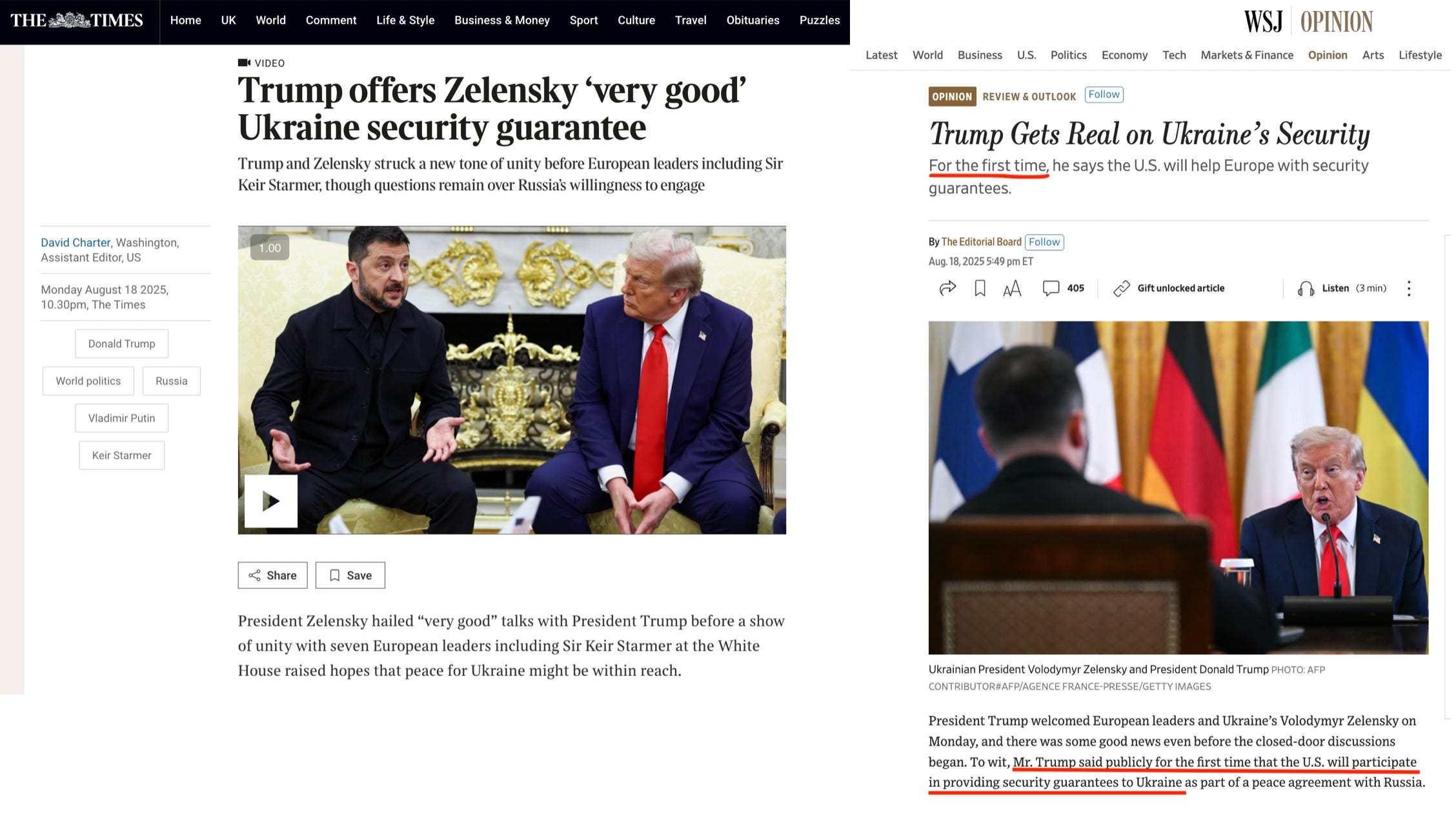
First thing Saturday morning, when the world’s press was castigating President Trump for Alaska, I said here on Substack: the only way forward diplomatically is a US offer of a security guarantee. Almost all Western journalists were paying attention to the wrong thing.
Consider the significance of the two:
- A ceasefire could (probably would) break down in a few days/weeks
- A security guarantee, constructed properly, is enduring. It’s a pathway to permanent peace.
The second is vastly more significant, and it ought to have been the US team’s priority in Alaska. It’s striking to me that so few reporters covering the talks saw that late Friday/early Saturday. And everyone was obsessed with both a “ceasefire” and red carpets/limo rides, reporters glossed over what President Trump had actually said on the Air Force One flight there.
With yesterday’s assembly of European leaders, we’ve finally come to see the significance.
In June, I kicked off publication of our full plan for Ukraine with two very intentionally chosen words: “Beyond Ceasefires”.
Despite the large gap that still exists, if President Trump can now get Presidents Zelensky and Putin in a room together, hopefully we can give the US administration due credit.
(For what it’s worth, I don’t understand why Trump does these Oval Office press gaggle meetings with Zelensky, fielding live questions before meetings. There seems almost no upside, journalists ask deliberately provocative questions – “How much money are you going to ask for, Mr. Zelensky?” – it invites unnecessary risk, and seems to me a waste of precious diplomatic time. Thankfully, they got through it.)
The questions the media at large is now asking: should there be US/European troops on the ground (as “peacekeepers”)? Which European countries should be involved, along with the US? Why would Russia go along with this? How’s it all to be paid for?
I answered all of these questions, and more, in a column for The Times on 21st February:
All he [the British Prime Minister] need do is combine diplomatic history with an understanding of President Trump and his closest advisors.
The first is the Rubik’s cube of a UK and Europe-fronted security guarantee. The Prime Minister would be banging his head against a brick wall to try to persuade President Trump to allow Ukraine into NATO… President Trump has said this will not happen, repeatedly, even whilst on the campaign trail in June (and having to look maximally tough).
The Prime Minister should use energy of the moment instead to forge something new: FRUKUS – an alliance of France, the United Kingdom, and the United States. In the acronym, the US deliberately coming last, with the US backstopping a security guarantee for only seven years. After seven years, US involvement sunsets, and Poland (which spends a commendable 4.1%+ [now 4.7%] of GDP on defence) and Germany replace the US to become “Friends of Ukraine and the US”.
Suggest to the President: “We want our continent to stand on its own two feet. Europe has a population five times that of Russia, and a combined GDP nearly ten times greater. We just ask for your generosity in providing a US backstop for the initial years to get FRUKUS off the ground credibly. Stabiliser wheels to bring the European bicycle into motion, if you will.” If the new US administration is banking now on warmer relations with Russia, and thinks, at least for the next few years, it can keep President Putin in check, this ought not to be too great an ask.
Unlike the 1994 Budapest Memorandum, which was an empty promise, all countries involved would provide an Article 5-strength guarantee to Ukraine (the territory Ukraine maintains behind a US-negotiated truce line). FRUKUS would thus not be a replication of the 1994 or Minsk agreements – neither of which were actual security guarantees (oft misstated, but clear to those who’ve taken the time to study the actual documents). The 1953 Korean Armistice [by contrast, an actual Mutual Defence Treaty], forged by newly elected Republican President Eisenhower, has stood the test of time – 71.5 years and counting. Eisenhower considered it his second greatest achievement (after D-Day)… Incidentally, President Eisenhower also clobbered the leader of the country he was protecting to enforce a peace.
Preserving some minimal US backstop following the seven years, the US does now have a small (~10,000 troop) permanent military base in Poland. Ric Grenell, then-US Ambassador to Germany, now Presidential Envoy for Special Missions, first entertained this (moving over a small portion of US troops stationed in Germany) in President Trump’s first term. Established in 2023, Garrison Poland might prove to be one prophetic act of President Biden.
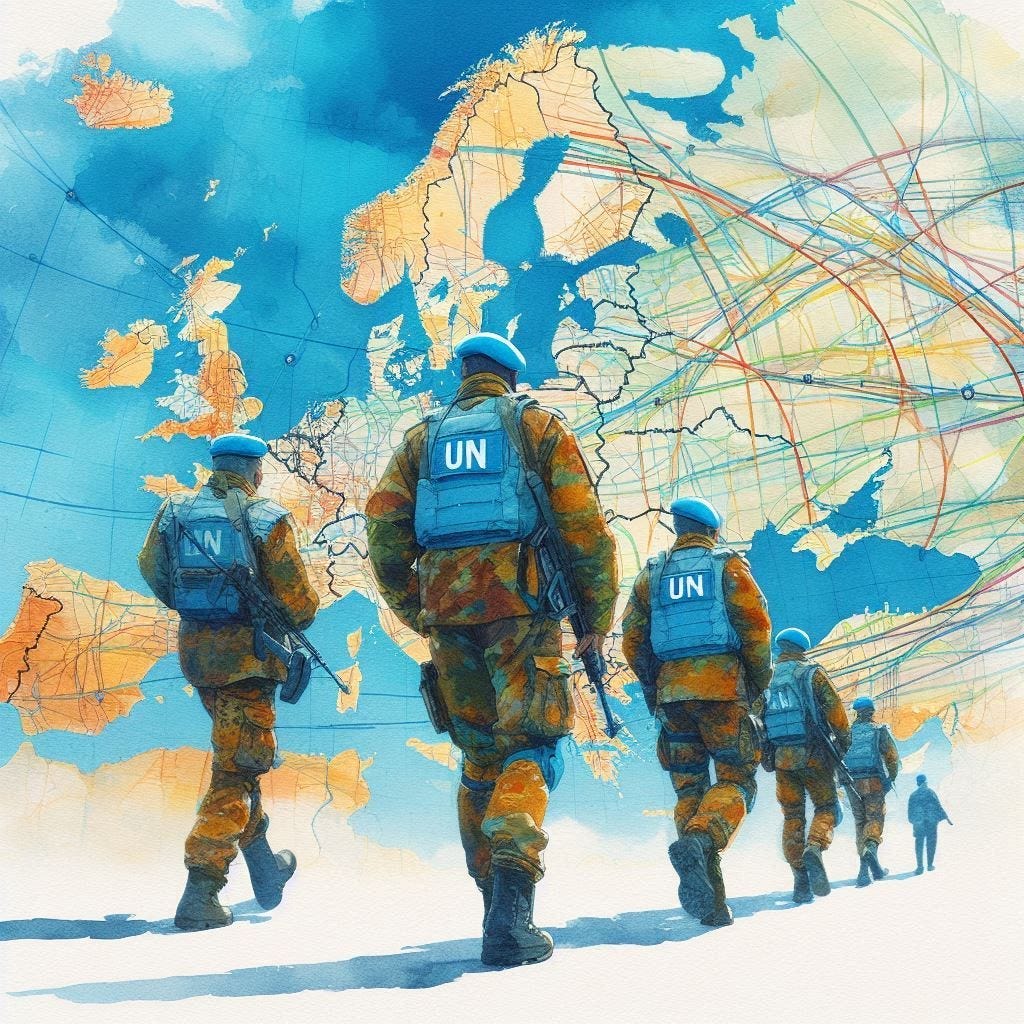
…What will surely now come to be referred to as the “47th parallel” between Ukraine and Russia is going to require a lot of peacekeepers. Suggested for the PM: “I’ve come to appreciate that this needs to be managed by United Nations peacekeepers (not Western troops or EU – effectively NATO – peacekeepers). We understand this is the only remedy that’s likely to be accepted by Russia
While the UK is fully committed to Ukraine’s defence, drop rhetoric of UK and French troops being stationed in Ukraine (which has a much sturdier home military than the Republic of Korea in 1953) – which could scupper US attempts at an expedient resolution. Instead, stick a new UK + French military base in east Poland: “Fort FRUK.” And rather than seeking to fly British military aircraft over Ukraine, ask the 47th President to consider re-joining the Open Skies Treaty (which Russia itself wants to rejoin), so that the Baltic states have better aerial visibility of any future Russian troop build-up.
How’s border security to be paid for? Not from the main UN budget (of which the US pays an outsized 25–27%, and the President’s team has already ruled out). Thankfully, the President’s Ukraine Envoy, Lt. General Kellogg, has the answer. In his America First Policy Institute report of April 2024, co-authored with Fred Fleitz: “We also call for placing levies on Russian energy sales to pay for Ukrainian reconstruction.” Why not extend this idea to fund UN peacekeeping troops? Secretary Rubio is signalling in this direction already.
Propose that Europe repair and restart one set of Nord Stream pipelines, and that a moderate supply of Russian energy finance Ukraine’s neutral peacekeepers (discharging talk of “a deal with the devil”, as European media presently puts it). A sensible amount of Russian energy supply with a levy would bring down European energy costs, keep American LNG prices competitive, and help bring down the recent rebound in US inflation. European natural gas prices are roughly four times higher than the United States’s. It can be made known that the US will not get European countries to spend 2.5%+ on defence sustainably (as is needed) without Europe having cheaper, diversified energy supply.
The UK can respectfully point out that the US might, in short order, prioritise less of its natural gas for European export. Post-Stargate and DeepSeek, the US could need more of its energy at home to power its Manhattan Project-level build out of AI data centres. Ukraine’s peacekeepers thus “administered by the United Nations; specially funded by a levy on responsible Russian energy flows to Europe”.
If one looks at a breakdown of countries from which UN peacekeeping troops are drawn, incredibly few are from Western countries, and virtually none are American. How many would be needed? Propose that Erik Prince, the founder of Blackwater, and a figure highly respected by the US top team, put forward a zero-bloat troop number and configuration. Many consider Erik to have had the best, cost-effective plan for Afghanistan, that the Pentagon did not pick up – which President Trump reportedly personally regrets. A border plan from Erik for Ukraine, with a Presidential rubber stamp (or Sharpie signature), then to be funded effectively by Europe and Russia jointly.
I wrote all this in February.
In some shape or form – whether the above ideas or others – a security guarantee plan is almost certainly going to get worked out in the coming days.
The Times writes this morning:
Russia, where the foreign ministry said it would not accept the deployment of a military contingent from Nato countries in Ukraine, saying such a force would be “fraught with unpredictable consequences”.
We’ll see how many days the British Prime Minister chooses to waste trying to push water uphill sticking with his present “coalition of the willing” plans – having UK and French troops in Ukraine – which will not fly, and Russia will not allow.
Accept this, and put British and French troops in east Poland instead – and actually build momentum with diplomacy. Or waste several weeks smashing your head against a wall, allowing thousands more to be killed, thinking you can pull a fast one on Russia and put NATO troops into Ukraine – stalling progress, and testing the patience of the US President.
*
For those who understandably think a security guarantee is a very dangerous idea – that, though it might solve the conflict now, it sets us up for very big risks of superpower/nuclear escalation in ~7 years’ time, when this conflict could kick off again…
I hear, and I share your concerns.
The historic breakthrough in offering from President Trump should *not* be celebrated (despite my having advocated for it) without corresponding extreme vigilance about the future risks it creates.
One crucial bit of history to keep in mind...
In forming NATO and Article 5…
President Truman could only get the Washington Treaty (the Treaty that established NATO) through the US Senate after Dean Acheson [then Secretary of State] provided a written assurance that it did not “automatically” commit the United States to military action in support of its NATO allies.
Senators Arthur Vandenberg and Tom Connally insisted that the treaty language preserve Congress’s constitutional prerogative to declare war and avoid automatic military obligations.
Under Article 5 of the treaty, each member is expected to take “such action as it deems necessary, including the use of armed force,” but that the specific response should be determined through each country’s constitutional processes. This means a US commitment to mutual defense is strong, but not automatic or compulsory. The decision on military action ultimately remains with Congress.
This nuance – being strong enough that it deters, though just cautious enough that it’s not automatic – needs to be emulated.
The history of the post-WWII negotiations of how this was arrived at is fascinating:
The wording of NATO’s Article 5 was the object of heated negotiations. Europeans wanted members to commit themselves to “military and other action”, while US diplomat George Kennan proposed only “such action as may be necessary”. Eventually, a compromise was reached. In the event of an attack, members will assist the relevant country “by taking forthwith… such action as it deems necessary, including the use of armed force”.
“Not since the ratification of the United States Constitution have so many men spent so much time drafting and debating so few words.” - NATO Research Division, April 2016
And a very important clause, that needs addition…
As I’ve written since February:
If Ukraine attacks Russia, the security guarantee should be rendered VOID, and Europe/the US will not support Ukraine. Any “false flag” attack by Ukraine should leave Ukraine without allies.
*
The fine details of a security guarantee need to be gotten right. But it seems likely at this point that a US+Europe security guarantee will be worked out.
The much thornier question is then going to be territory. How to get a solution that’s sellable – to Ukraine domestically, and throughout Europe (opposed to where President Trump seems presently to be at)? It’s going to require something imaginative.
I have five creative ideas, and as this email is long enough already, notwithstanding any major unexpected event, territory and what to do about it will be the subject of my email tomorrow…