
An alternate take on Trump’s Alaska summit...

In early December, five weeks after President Trump’s election victory, I began soliciting feedback on an attempt to answer the impending question: “How could one construct a security guarantee for Ukraine that would work, politically and militarily, for all sides?” My first draft:
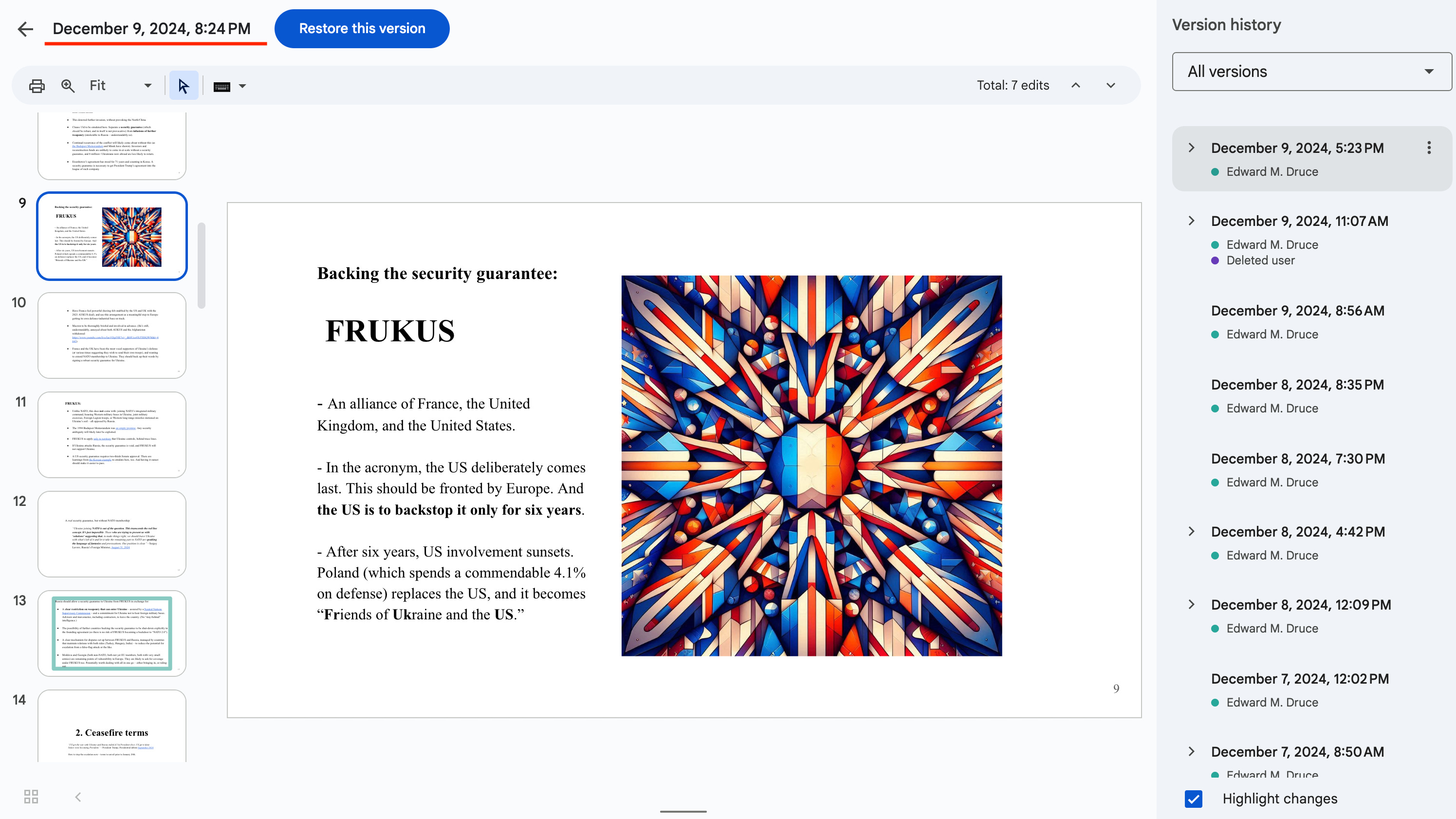
“FRUKUS”, of course, sounds like a joke. It’s a tongue-in-cheek play on the nuclear agreement AUKUS. But when getting into the serious detail of the suggestion, the document was largely praised – including by high-ranking military personnel I put it before: “I have not heard any suggestion better.”
I received helpful feedback from many (that has since been incorporated on the above slide): include Germany as well as Poland; six years definitely isn’t long enough, make the sunset period longer…
And over the past nine months, I’ve continued to solicit such feedback.
It was abundantly clear to me that President Trump was never going to allow Ukraine to become a NATO member.
But – while being critiqued by a lot of people, and I appreciate to this day there are downsides and severe future risks to the suggestion, if handled unwisely – I’ve long believed that a security guarantee is a necessary first step to achieving an armistice in Ukraine. Looking at the politics of Europe, Ukraine and the US together – and Russia’s unyielding demands – I cannot see a way that the war can be stopped without one.
So, while most news this morning is reporting, “Trump rolled out the red carpet for Putin and got nothing back”, I think that one comment made by President Trump in the past 24 hours is extremely significant.
Aboard Air Force One, en route to Alaska, the President was asked: “What about the possibility of the United States providing security guarantees to Ukraine?”
The President’s answer (15 second clip):
“Maybe – along with Europe and other countries. Not in the form of NATO, because that’s not going to happen. There are certain things that aren’t going to happen. But yeah, along with Europe [while nodding], there’s a possibility of that.”
This is huge. I’m quite sure President Trump has not said as much anywhere else to date. With the theatre of Presidents Trump and Putin sharing a ride in “The Beast” (limo) together, the remark seems to have been overlooked in its significance.
Though Zelensky did echo it in his tweet following a debriefing call with Trump:
“We also discussed positive signals from the American side regarding participation in guaranteeing Ukraine’s security.”
A further comment of note, made in President Trump’s interview with Sean Hannity immediately after the summit meeting:
“Now it’s really up to President Zelensky to get it done, and I would also say the European nations, they have to get involved a little bit.”
*
For the past nine months, I’ve had conviction that the only way to end the war is to i) Give Ukraine some kind of US security guarantee, ii) Be very harsh in enforcing territorial concessions – undesirable though these are.
Forgotten now to history, in bringing about the 1953 Korean Armistice, President Eisenhower endured a near revolt by Republican senators against his own administration. (Today, the equivalent would be European leaders.) And the South Korean President was so opposed to the terms he never personally signed the document! (His military general had to do so.)
This was an extremely ugly (and unfair) peace.
Eisenhower’s biographer, Stephen E. Ambrose:
“There were no victory celebrations, no cheering crowds in Times Square, no sense of triumph. Instead Republicans like Jenner, Dewey Short, McCarthy, and House Speaker Joe Martin complained because the Administration had not sought victory, while Lyndon Johnson warned that the armistice ‘merely releases aggressive armies to attack elsewhere’.
The armistice was, despite its reception, one of Eisenhower’s greatest achievements. He took great pride in it. Despite intense opposition from his own party, from his Secretary of State [John Foster Dulles], and from Syngman Rhee [President of South Korea], he had ended the war six months after taking office. Eisenhower [was] the only American who could have found and made stick what he called ‘an acceptable solution to a problem that almost defied solution’.”
The first step to achieving the 1953 armistice – the first side to “give” – was the US, in extending the promise of a post-ceasefire security guarantee.
With great internal reluctance – “an open admission on our part that Rhee [equivalent from a US perspective today to Zelensky] has the whip hand”, Eisenhower felt, in granting a security guarantee, he was “surrendering to Rhee’s blackmail”. But “finally [after six months] Eisenhower agreed [to offer one]… To quit would have been political disaster.”
There are very real reasons for not wanting to offer Ukraine a security guarantee – for future Western credibility, and the potential of future nuclear escalation. But it’s also the only way I can see out.
President Rhee of South Korea, on receiving the promise of Eisenhower’s security guarantee, still nearly undermined the entire peace process (as I believe would not be beyond Zelensky). But it just about bridged the divide to get sides to agree to lay down their arms.
Europe has displayed greater resolve in backing Ukraine than President Trump anticipated in his return to power – commenting a few weeks ago, in a meeting with NATO Secretary General Mark Rutte in the Oval Office:
“I have to tell you, Europe has a lot of spirit for this war. A lot of people – when I first got involved, I really didn’t think they did. But they do. And I saw that a month ago, many of you were there. The level of esprit de corps, of spirit, that they have is amazing. They really think it’s a very, very important thing to do [defending Ukraine].”
A quip often attributed to Churchill: “You can always count on Americans to do the right thing, after they’ve tried everything else.” Following the Alaska meeting, I feel as though we might be approaching the “tried everything else” stage.
The “right thing” today – to stop the bloodshed, and tens of thousands of men my age being put to the slaughter – as I’ve been arguing since December, is a combination of:
i) A non-NATO security guarantee for Ukraine, with some US backing
ii) Very unappetising territorial concessions – which it’s relatively clear from a lack of US media update post-summit, Russia ain’t budging on
I’ll spare it for Substack, but the below is a latest reiteration, in just 1,000 words, of precisely what President Trump’s latest sentiment of a Europe-led/US-supported security guarantee for Ukraine could look like:
https://docs.google.com/document/d/18xdMW7yvvcCKr3iaLslIr-ILeTr2dUNLAEqRomzPCTo/edit?usp=sharing
In the number of iterations, perhaps we’ll call it “FRUKUS 3.0”.
This document is written with senior US decision-makers as the target audience – and thus will feel insensitive to the majority of British and European readers.
But, if there’s any shot of getting this war wrapped up in the coming months, it’s the US that I believe needs to be persuaded and encouraged (in offering such a plan, as step #1). If President Trump can be, yesterday’s trip to Alaska will have been worthwhile as a step to advancing peace, and Europe getting its own defence readiness together – despite all journalistic noise to the contrary.